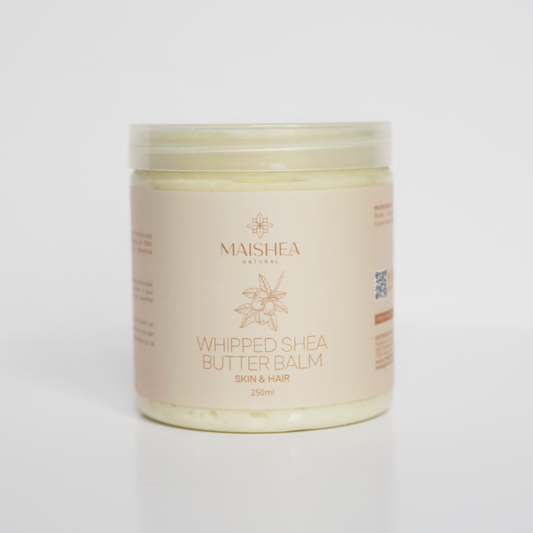
You may have noticed this summer: your Maishea Natural whipped shea balm changed texture. Softer, more fluid, sometimes even slightly liquid if you left it near a sunny window. And your first reaction may have been to wonder if your product was damaged, expired, or if something had gone wrong.
Let me reassure you right away: that is not the case. What you are observing is exactly what is supposed to happen. And I will explain why, as a formulator, I consider this melting to be one of the best proofs of the quality of what you hold in your hands.
What exactly is whipped shea butter?
Before we get to the heart of the matter, a quick vocabulary point. What you call "shea chantilly" or "whipped shea butter" is what I call a whipped balm in my formulas: raw shea butter, mechanically worked cold to incorporate air and obtain that light, foamy, melting texture you know.
No added wax. No emulsifier. No chemical stabilizer. Just raw unrefined shea, carefully whipped, to which I've added aloe vera and sesame oil to amplify its moisturizing properties.
It is precisely this simplicity of formulation that explains its behavior in summer.
Why does it melt at 28-30°C?
Raw shea butter has a natural melting point between 28 and 36°C depending on its origin and composition. In my formulas, I observe that from 28-30°C, the texture begins to soften significantly, and beyond 34°C, it can become completely liquid.
It's not a defect. It's physics.
Shea butter is composed of a complex mixture of fatty acids — mainly stearic acid and oleic acid — whose proportions naturally vary from one harvest to another, from one region to another. It is this unique composition that gives it its exceptional properties for the skin... and it is also what determines its behavior when exposed to heat.
At 28°C in your apartment in the middle of summer, or in your beach bag left in the sun, your whipped balm will naturally soften, or even partially melt. This is completely normal. And I sincerely tell you, it's even very good news.
What melting tells you about your product
Here's what I tell my customers at markets when they ask me this question, and it's important to understand:
If your whipped shea butter doesn't melt in summer, ask questions.
Industrial products that display "shea" on their label but maintain a perfectly stable texture at 35°C almost systematically contain thickening agents, synthetic waxes, emulsifiers or stabilizers that mask shea's natural behavior. Some contain only a tiny proportion — just enough to be able to mention it on the packaging.
A whipped balm that melts slightly in summer is proof that you have a true, pure, unaltered product in your hands. It's shea behaving as it would in nature, in sub-Saharan Africa, under the sun.
As a formulator, I could have added stabilizing agents to guarantee you an unchangeable texture all year round. I deliberately chose not to, because these additives do not benefit your skin and compromise the purity of the formula.
Does melting change the product's properties?
Absolutely not. This may be the most important question, so I will be very clear.
Whether your balm is whipped, softened, or even completely liquid, its active properties remain 100% intact. The fatty acids, vitamins A and E, the unsaponifiable fraction with anti-inflammatory properties — all of this is perfectly stable in the face of summer heat. Melting is a change of physical state, not chemical degradation.
And an added bonus: a slightly melted balm applies even more easily to the skin, penetrates faster, and spreads more evenly over large areas like legs or back. Some of my customers even tell me they prefer its summer texture for this reason.
How to best store your balm in summer?
That said, I understand that you might prefer to regain that foamy, airy texture you love. Here are my formulator tips to achieve this:
Store it in a cool place, away from direct light. A cupboard in a room that doesn't overheat, away from windows, is ideal. Avoid the bathroom if it's exposed to the sun, and especially avoid leaving it in your car.
You can put it in the refrigerator. It is completely safe and even very pleasant in summer. The balm firms up when cool, and applying a slightly cool balm to heated skin after the beach or a hot day is a particularly soothing sensation — especially for eczema-prone skin that suffers from the heat.
If it has melted, simply let it cool. Place it in the refrigerator for 30 minutes to 1 hour: it will resolidify and regain a texture similar to the original. It is possible that the whipped texture may be slightly less airy than when purchased — this is normal, as the air bubbles incorporated during manufacturing escape upon melting — but the product remains perfectly usable and just as effective.
Do not re-whip it yourself. I know the idea might seem logical, but mechanically re-working the butter at home without the hygienic conditions of a workshop can introduce contaminants into the product. Simply let it cool and use it as is.
A word about outdoor markets
I regularly sell at markets, and in summer, it's a real challenge for my products exposed to direct sunlight. I always make sure to protect my balms from direct heat during markets, with coolers or shaded covers. If you buy a Maishea Natural product at a market in summer and you notice that the texture is softer than usual, it's simply the effect of the ambient heat — and not a sign that the product has been poorly stored or has lost its qualities.
In summary
| What it means | |
|---|---|
| My balm melts at 28-30°C | ✅ Sign of purity — raw shea behaves naturally |
| Do its properties change? | ✅ No — benefits intact regardless of texture |
| Ideal storage | Cool place, away from sunlight or in the refrigerator |
| It has melted, what to do? | Put it in the fridge for 30-60 min, it will resolidify |
| Melted texture = expired product? | ❌ No — use it normally, it is still active |
Next time you see your whipped shea butter softened at the bottom of its jar, smile. It's a sign that you've chosen an honest, pure, and uncompromisingly formulated product.
That's exactly what I wanted to create when I launched Maishea Natural.
— Founder of Maishea Natural
Find our Whipped Shea Butter with Aloe Vera and Sesame Oil on maisheanatural.com